


ORGANS OF PARIS © 2026 Vincent Hildebrandt HOME ALL ORGANS



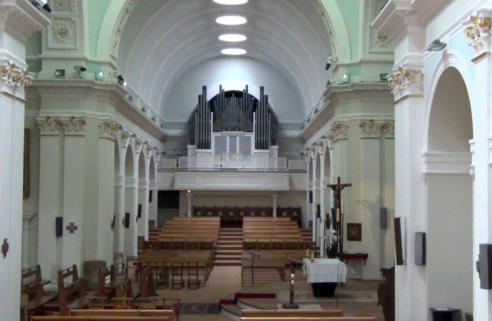
Originally, this chapel was the chapel of the
convent of the Fathers of Mercy on Rue de
Varennes in Paris. It has simply been transported
stone by stone to Passy when the fathers were
expelled in 1881.
It is dedicated in 1928 to Our Lady of the
Assumption of Passy, in view of the nuns of the
Assumption whose convent is further down the
same street. The chapel was enlarged in 1934 by
the architect Labro with the addition of aisles.
Finally, in 1952, a second nave was built. Notre-
Dame-de-l'Assumption-de-Passy is neo-classical
in style with a beautiful dome at the crossroads
of the two naves.


D5
A first organ was built at the end of the 19th century by the
Abbey workshop of Versailles for the Church of
Notre‑Dame de l’Assomption in Passy, Paris. When the church
was enlarged around 1952, the original organ was purchased
by the parish of Sainte‑Bernadette in Brignogan (Finistère),
where it still resides today. More info…
The current organ of Notre‑Dame de Passy has undergone
several transformations and has changed hands at least three
times.
It was built by Charles Mutin at the very beginning of the
20th century. We know nothing about the instrument’s first
owner—presumably a wealthy private organ enthusiast or a
small community.
In 1928 the organ was bought by Count Léonce de
Saint‑Martin, titular organist of Notre‑Dame de Paris, for his
apartment on Place des Vosges. Gutschenritter re‑voiced the
instrument and took the opportunity to make a few
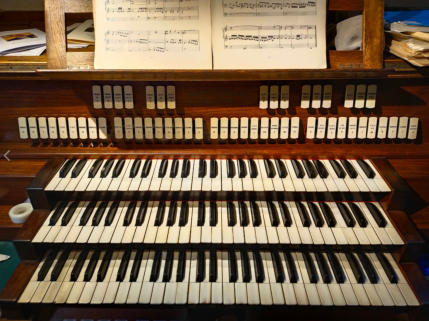
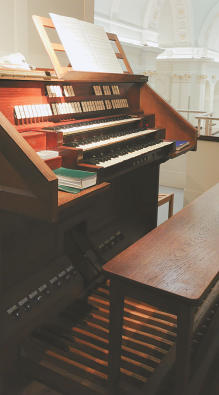
modifications and additions to Mutin’s organ, including a
third keyboard that carries no stops but serves as a coupler
manual, thereby giving the organist more possibilities. At that
time the instrument had 19 stops.
Canon Boulard, pastor of the Church of Notre‑Dame de
l’Assomption, had carried out expansion work on the church
in the 1950s and was looking to replace the modest organ
that occupied the second gallery at the back of the nave.
Around that time Emmanuel de Villèle, then the church’s
titular organist, learned that Léonce de Saint‑Martin’s organ
was for sale. He promptly informed Canon Boulard, who
acquired it.
The instrument was re‑voiced by Beuchet‑Debierre. Major
enlargement and electrification work were undertaken to
adapt the organ to the church’s dimensions and to increase
its musical possibilities. The essentially romantic organ was
transformed into a neoclassical instrument, in line with the
prevailing style of the era. The overall re‑voicing was
entrusted to the harmonist Jacques Picaud, a Parisian
collaborator of the Beuchet firm.


190x - Charles Mutin (1)
1928 - Gaston Gutschenritter (3a)
1959 - Beuchet-Debierre (3a)
III/38 (29) - electrical traction
stoplist

Titular organist
Léonid Karev
Parish website
Photos
Buffet et Eglise : Vincent Hildebrandt
Console : Gaspard de LaMotte


Organs of Paris


ORGANS OF PARIS © 2026 Vincent Hildebrandt
D5
A first organ was built at the end of the 19th century by the
Abbey workshop of Versailles for the Church of
Notre‑Dame de l’Assomption in Passy, Paris. When the church
was enlarged around 1952, the original organ was purchased
by the parish of Sainte‑Bernadette in Brignogan (Finistère),
where it still resides today. More info…
The current organ of Notre‑Dame de Passy has undergone
several transformations and has changed hands at least three
times.
It was built by Charles Mutin at the very beginning of the
20th century. We know nothing about the instrument’s first
owner—presumably a wealthy private organ enthusiast or a
small community.
In 1928 the organ was bought by Count Léonce de
Saint‑Martin, titular organist of Notre‑Dame de Paris, for his
apartment on Place des Vosges. Gutschenritter re‑voiced the
instrument and took the opportunity to make a few
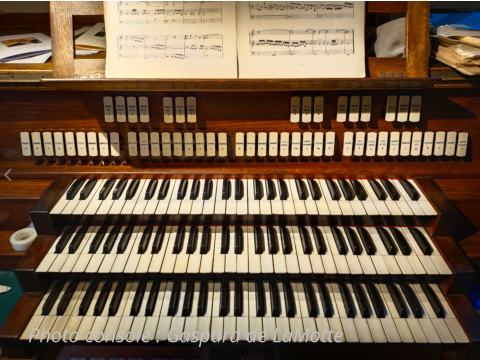
modifications and additions to Mutin’s organ, including a
third keyboard that carries no stops but serves as a coupler
manual, thereby giving the organist more possibilities. At that
time the instrument had 19 stops.
Canon Boulard, pastor of the Church of Notre‑Dame de
l’Assomption, had carried out expansion work on the church
in the 1950s and was looking to replace the modest organ
that occupied the second gallery at the back of the nave.
Around that time Emmanuel de Villèle, then the church’s
titular organist, learned that Léonce de Saint‑Martin’s organ
was for sale. He promptly informed Canon Boulard, who
acquired it.
The instrument was re‑voiced by Beuchet‑Debierre. Major
enlargement and electrification work were undertaken to
adapt the organ to the church’s dimensions and to increase
its musical possibilities. The essentially romantic organ was
transformed into a neoclassical instrument, in line with the
prevailing style of the era. The overall re‑voicing was
entrusted to the harmonist Jacques Picaud, a Parisian
collaborator of the Beuchet firm.

190x - Charles Mutin (1)
1928 - Gaston Gutschenritter (3a)
1959 - Beuchet-Debierre (3a)
III/38 (29) - electrical traction
stoplist
Titular organist
Léonid Karev
Parish website
Photos
Buffet et Eglise : Vincent Hildebrandt
Console : Gaspard de LaMotte
